
Around 15 years ago, I picked up a chamfer plane on eBay that immediately stood out as something different. Branded “RADI-PLANE – L.A. Mathers Co., Stockton, Calif”, it bore little resemblance to any other plane in my collection—and it didn’t take long to realise that this was no ordinary tool.
The first thing that caught my attention was its twin-blade configuration. Unlike a traditional chamfer plane, this one features a second blade positioned roughly two inches behind the first. The body itself is wooden, but the sole incorporates a coated steel “V” groove. Both blades mirror this profile, though instead of forming a sharp corner, they are radiused—designed to produce a rounded edge on the workpiece rather than a crisp chamfer.
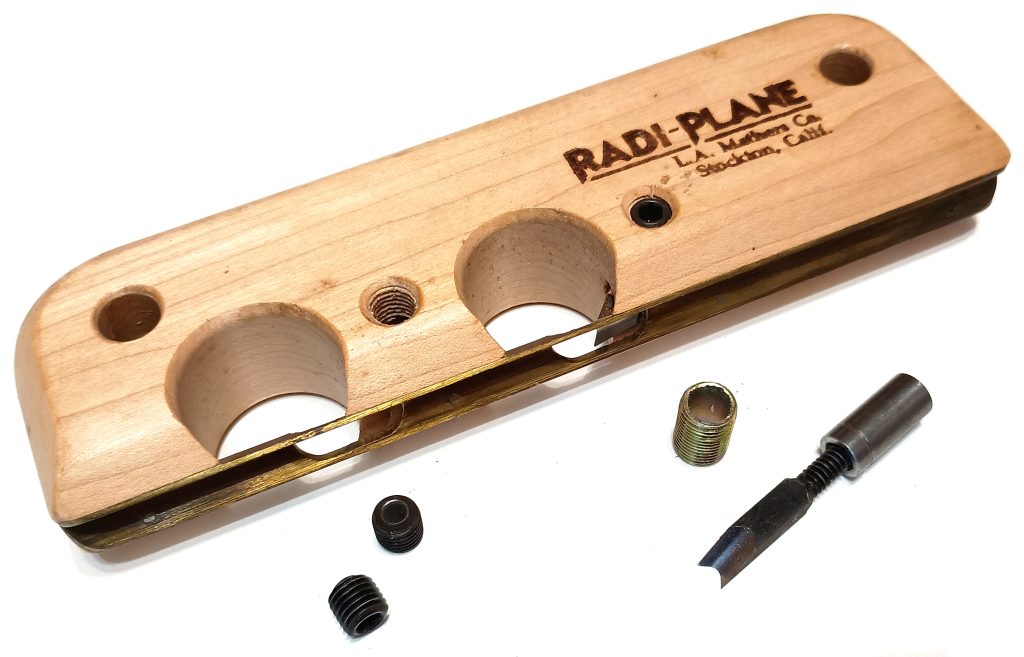
Both blades are identical and bedded at 45°, bevel down, forming an inverted “V” when viewed together. Their mounting system is quite ingenious, if not a little unconventional. Each blade has a threaded top that engages with an internally threaded tube. This assembly is then secured by a hollow, externally threaded tube inserted from the top of the plane.
Assembly reveals a very deliberate sequence:
- The blade is inserted through the sole
- The internally threaded tube is fed in from the top and engaged using an Allen key
- The outer threaded tube is then screwed down to lock the assembly in place
Adjustment is carried out via an Allen key inserted through the hollow tube to turn the internal thread. Once set, the blades are centred and locked in position using grub screws from the sides of the body.
As I didn’t receive any instructions with the plane, understanding this system took a fair bit of trial and error. Each adjustment required loosening the grub screws, resetting the blade depth, tightening everything back up, and then testing the cut. When properly tuned, the front blade takes a light shaving, while the rear blade follows with a slightly heavier cut. Getting that balance right, however, was not a quick process.
A Rare and Somewhat Obscure Tool
Information on the Radi-Plane is surprisingly scarce. I’ve only come across a handful of references online, mostly buried in forums or mentioned briefly in instructional videos. One particularly interesting discussion suggested that these planes were available with two blade styles: a flat profile for standard chamfers, and a curved profile—like mine—for producing a rounded edge (approximately 1/8”).
While original Radi-Planes appear to be long out of production, I did discover that Rockler Woodworking and Hardware offered a very similar tool as recently as 2019—the Rockler Carbide-Tipped Radius Plane. Although no longer listed on their website, heavily discounted replacement blades are still available. The most notable difference is that the Rockler version used carbide-tipped cutters rather than the all-steel blades found in the Radi-Plane.
Modern Alternatives
Curiosity led me to explore what modern equivalents might be available. A bit of searching turned up a couple of interesting options, both manufactured in China.


The first is a 6-inch metal-bodied plane fitted with a single blade, but supplied with a set of seven interchangeable cutters of varying profiles. These blades share some design similarities with the Radi-Plane—square stock machined to shape with a threaded end—but are noticeably larger. Adjustment is much simpler, using a thumbwheel mechanism, and once set, the blade is locked in place with a side-mounted thumbscrew. It’s a far more user-friendly system compared to the Radi-Plane’s somewhat fiddly arrangement.
The second is a smaller plane, around 4¾ inches long, with a wooden body and a thick (3/16”) blade secured by a brass cap and screw. This one is much more traditional in design, and adjustment is, again, a matter of trial and error—tapping the blade into position and testing the result.
Final Thoughts
The Radi-Plane is a fascinating example of a specialised tool that attempts to solve a very specific problem—producing consistent, radiused edges—through an inventive but somewhat complex mechanism. While it may not be the most convenient plane to set up and use, it certainly earns its place as an interesting and uncommon piece in the collection.
For me, it’s a reminder that not all tool innovation leads to widespread adoption—but that doesn’t make it any less worthy of exploration.
Radi-Plane References
https://forum.shopsmith.com/viewtopic.php?t=21319
https://smallboatsmonthly.com/article/cutting-corners
https://papawswrench.com/vboard/index.php?topic=23843.0
https://forums.woodnet.net/showthread.php?tid=7275613
Tools I Love: Radi-Plane | WoodWorkers Guild of America
Rockler Carbide-Tipped Radius Plane Review – Concord Carpenter